


hinline semi-acoustic guitars were all the rage in the mid 1960s. The blues guitarists that had been playing them since the late fifties were being emulated by the groups of the time. The likes of John Lennon, George Harrison, Paul McCartney and Keith Richards had made the Epiphone Casino very popular - whilst other guitarists were playing the blues on Gibson ES-335s (Eric Clapton, Alvin Lee) or the Guild Starfire (Dave Davies). Less expensive semis such as the Harmony H76 and Hofner Verithin were selling in absolutely huge numbers.
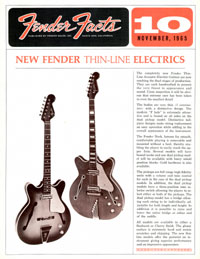
The Coronado series was announced in November 1965 in the Fender newsletter Fender Facts. The guitars are said to be in the final stages of production. The Coronado II pictured has a different bridge and switch position to the production version.
In late 1965 Fender attempted to capture some of the lucrative thin-line semi acoustic market, by announcing a range of semi acoustics of it's own. The range was designed by ex-Rickenbacker guitar designer, Roger Rossmeisl, who left in some Rickenbacker touches like checkered binding, and F-tailpiece. The guitars were all-maple, with pickups designed by DeArmond. Fender had considered the names 'Fender Fantasy' and 'Fender Aztec', but finally settled on Coronado. They were described as follows:
The bodies are very thin (5 centimeters) with a distinctive design. The modern "F hole" is extremely attractive and is bound on all sides on the dual pickup model.
The pickups are full-range high fidelity units with a volume and tone control for each in the case of the dual pickup models. In addition, the dual pickup models have a three-position tone selector switch allowing the player to select either or both of the pickups.
The Coronado series was not actually available for several more months, and was first included in the price list of July 1966. There were single and double pickup six strings, a twelve string and a single pickup Coronado bass. Tremolo's were listed as an optional extra. By 1967 a dual pickup Coronado Bass II was added to the line. Early publicity images show the guitars placed next to sheet music by the Byrds and the Yardbirds - it was clear who these guitars were aimed at.
Launch prices were close to those of the Gibson ES-330TD and Epiphone Casino; the Coronado was a nice guitar, but whether it was in the same league as the fore mentioned models is debatable. The commercial failure of the Coronado - at least in comparison to Fender's solid body models - strongly suggests that the guitar buying public tended to think not. Some 1966 prices are shown below.
1967 Fender Coronado II in Antigua finish Image Heritage auctions
Fender described their new Antigua finish as follows:
Fender's latest color dimension, the Antigua, puts elegance in the spotlight. This inimitable new finish is a rich, antique white with a halo mist shading which produces a subtle feeling of depth and dimension.
Fender had been injecting dyes into growing beech trees, in order to create interesting grain effects for the Wildwood acoustic guitar. When harvested the wood was primarily green, blue or brown - giving rise to three actual finishes - Wildwood I (Rainbow Green), Wildwood II (Rainbow Blue), and Wildwood III (Rainbow Gold). The very nature of the process meant that each Wildwood guitar was unique; "the color follows the grain and becomes a rainbow of colors and patterns. This causes each instrument to differ from the next"